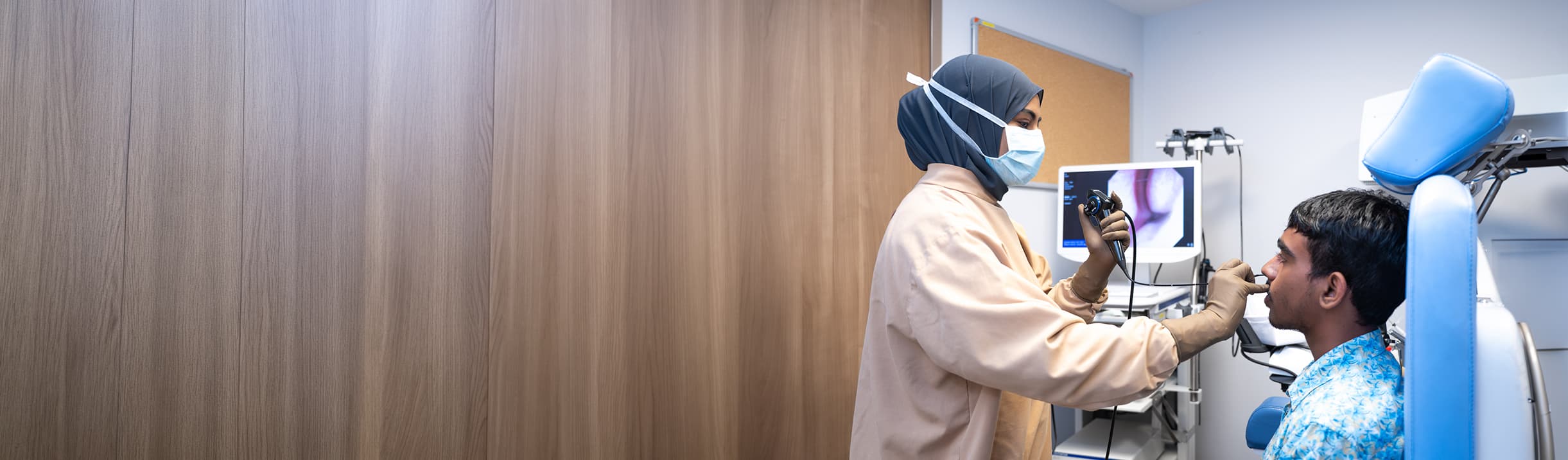
Naso-Pharyngo-Laryngo Endoscopy
Naso-Pharyngo-Laryngoscopy (NPL) is a minimally invasive, in-office procedure using a thin, flexible, lighted camera to visualize the nasal cavity, nasopharynx, and larynx/vocal cords
Suture Removal
Routine procedure, usually done 10–14 days post-surgery, involving cleansing the wound, lifting each knot with forceps, and cutting the suture close to the skin on one side of the knot before pulling it out
Needle Aspiration
Minimally invasive, low-risk diagnostic procedure used to collect cells, fluids, or tissue samples from lumps or abnormalities, commonly in the thyroid, breast, or lymph nodes
FEES
A Fiberoptic Endoscopic Evaluation of Swallowing (FEES) is a 10–15 minute, low-risk, in-office procedure where an ENT or Speech-Language Pathologist passes a flexible camera through the nose to directly view the throat during swallowing
Adenoidectomy
Common, 20- to 30-minute outpatient surgical procedure to remove enlarged or infected adenoid glands, located behind the nose
Tonsillectomy
Common surgical procedure that removes the tonsils at the back of the throat, usually performed under general anesthesia to treat chronic tonsillitis, persistent infections, or breathing/sleep issues (like sleep apnea) caused by enlarged tonsils
Adenotonsillectomy
Common, 45-60 minute surgical procedure under general anaesthesia to remove both the tonsils and adenoids, primarily performed in children to treat obstructive sleep apnoea (OSA), sleep-disordered breathing, and recurrent infections
Septoplasty
Common, often outpatient, surgical procedure used to straighten a deviated septum—the bone and cartilage dividing the nostrils
Tracheostomy
Surgical procedure that creates an opening (stoma) in the neck and trachea (windpipe) to allow direct access to the airway, enabling breathing when the upper airway is obstructed or when long-term ventilator support is needed
Myringoplasty
Surgical procedure to repair a perforated (holed) eardrum by grafting tissue to close the defect
Naso-Pharyngo-Laryngo Endoscopy
Naso-Pharyngo-Laryngoscopy (NPL) is a minimally invasive, in-office procedure using a thin, flexible, lighted camera to visualize the nasal cavity, nasopharynx, and larynx/vocal cords
Suture Removal
Routine procedure, usually done 10–14 days post-surgery, involving cleansing the wound, lifting each knot with forceps, and cutting the suture close to the skin on one side of the knot before pulling it out
Needle Aspiration
Minimally invasive, low-risk diagnostic procedure used to collect cells, fluids, or tissue samples from lumps or abnormalities, commonly in the thyroid, breast, or lymph nodes
FEES
A Fiberoptic Endoscopic Evaluation of Swallowing (FEES) is a 10–15 minute, low-risk, in-office procedure where an ENT or Speech-Language Pathologist passes a flexible camera through the nose to directly view the throat during swallowing
Adenoidectomy
Common, 20- to 30-minute outpatient surgical procedure to remove enlarged or infected adenoid glands, located behind the nose
Tonsillectomy
Common surgical procedure that removes the tonsils at the back of the throat, usually performed under general anesthesia to treat chronic tonsillitis, persistent infections, or breathing/sleep issues (like sleep apnea) caused by enlarged tonsils
Adenotonsillectomy
Common, 45-60 minute surgical procedure under general anaesthesia to remove both the tonsils and adenoids, primarily performed in children to treat obstructive sleep apnoea (OSA), sleep-disordered breathing, and recurrent infections
Septoplasty
Common, often outpatient, surgical procedure used to straighten a deviated septum—the bone and cartilage dividing the nostrils
Tracheostomy
Surgical procedure that creates an opening (stoma) in the neck and trachea (windpipe) to allow direct access to the airway, enabling breathing when the upper airway is obstructed or when long-term ventilator support is needed
Myringoplasty
Surgical procedure to repair a perforated (holed) eardrum by grafting tissue to close the defect
Naso-Pharyngo-Laryngo Endoscopy
Naso-Pharyngo-Laryngoscopy (NPL) is a minimally invasive, in-office procedure using a thin, flexible, lighted camera to visualize the nasal cavity, nasopharynx, and larynx/vocal cords
Suture Removal
Routine procedure, usually done 10–14 days post-surgery, involving cleansing the wound, lifting each knot with forceps, and cutting the suture close to the skin on one side of the knot before pulling it out
Needle Aspiration
Minimally invasive, low-risk diagnostic procedure used to collect cells, fluids, or tissue samples from lumps or abnormalities, commonly in the thyroid, breast, or lymph nodes
FEES
A Fiberoptic Endoscopic Evaluation of Swallowing (FEES) is a 10–15 minute, low-risk, in-office procedure where an ENT or Speech-Language Pathologist passes a flexible camera through the nose to directly view the throat during swallowing
Adenoidectomy
Common, 20- to 30-minute outpatient surgical procedure to remove enlarged or infected adenoid glands, located behind the nose
Tonsillectomy
Common surgical procedure that removes the tonsils at the back of the throat, usually performed under general anesthesia to treat chronic tonsillitis, persistent infections, or breathing/sleep issues (like sleep apnea) caused by enlarged tonsils
Adenotonsillectomy
Common, 45-60 minute surgical procedure under general anaesthesia to remove both the tonsils and adenoids, primarily performed in children to treat obstructive sleep apnoea (OSA), sleep-disordered breathing, and recurrent infections
Septoplasty
Common, often outpatient, surgical procedure used to straighten a deviated septum—the bone and cartilage dividing the nostrils
Tracheostomy
Surgical procedure that creates an opening (stoma) in the neck and trachea (windpipe) to allow direct access to the airway, enabling breathing when the upper airway is obstructed or when long-term ventilator support is needed
Myringoplasty
Surgical procedure to repair a perforated (holed) eardrum by grafting tissue to close the defect
Naso-Pharyngo-Laryngo Endoscopy
Naso-Pharyngo-Laryngoscopy (NPL) is a minimally invasive, in-office procedure using a thin, flexible, lighted camera to visualize the nasal cavity, nasopharynx, and larynx/vocal cords
Suture Removal
Routine procedure, usually done 10–14 days post-surgery, involving cleansing the wound, lifting each knot with forceps, and cutting the suture close to the skin on one side of the knot before pulling it out
Needle Aspiration
Minimally invasive, low-risk diagnostic procedure used to collect cells, fluids, or tissue samples from lumps or abnormalities, commonly in the thyroid, breast, or lymph nodes
FEES
A Fiberoptic Endoscopic Evaluation of Swallowing (FEES) is a 10–15 minute, low-risk, in-office procedure where an ENT or Speech-Language Pathologist passes a flexible camera through the nose to directly view the throat during swallowing
Adenoidectomy
Common, 20- to 30-minute outpatient surgical procedure to remove enlarged or infected adenoid glands, located behind the nose
Tonsillectomy
Common surgical procedure that removes the tonsils at the back of the throat, usually performed under general anesthesia to treat chronic tonsillitis, persistent infections, or breathing/sleep issues (like sleep apnea) caused by enlarged tonsils
Adenotonsillectomy
Common, 45-60 minute surgical procedure under general anaesthesia to remove both the tonsils and adenoids, primarily performed in children to treat obstructive sleep apnoea (OSA), sleep-disordered breathing, and recurrent infections
Septoplasty
Common, often outpatient, surgical procedure used to straighten a deviated septum—the bone and cartilage dividing the nostrils
Tracheostomy
Surgical procedure that creates an opening (stoma) in the neck and trachea (windpipe) to allow direct access to the airway, enabling breathing when the upper airway is obstructed or when long-term ventilator support is needed
Myringoplasty
Surgical procedure to repair a perforated (holed) eardrum by grafting tissue to close the defect